You’re growing…
but nothing is getting easier.
Everything still depends on you.
As organizations grow, complexity increases. Decisions slow. Leadership alignment weakens. Execution becomes inconsistent.
Many leaders assume this friction is simply the cost of growth. It is not.
Most organizations are paying a hidden tax caused by weaknesses in their Architecture of Trust.
The CEO’s Invisible Problem
Everything should be working.
More people.
More leaders.
More resources.
But it’s not.
Alignment breaks.
Decisions slow.
Execution slips.
So you step in more.
And still—
it doesn’t hold.
It’s not talent.
It’s structural.
What Is Architecture of Trust
The Architecture of Trust is an organizational discipline that governs how leadership alignment, decision clarity, and execution reliability function within an enterprise. It describes the structural systems that dictate how organizations build, lose, and repair trust.
The Architecture of Trust Model
Trust inside organizations is reinforced by three structural systems.
When these systems reinforce one another, organizations accelerate.
When they weaken, friction appears and organizational speed declines.
What’s actually breaking
Alignment breaks. Decisions slow. Execution slips.
Most try more communication, more meetings, better people.
It doesn’t work.
These aren’t separate problems.
When alignment breaks, decisions slow.
When decisions slow, execution fails.
This is structural.
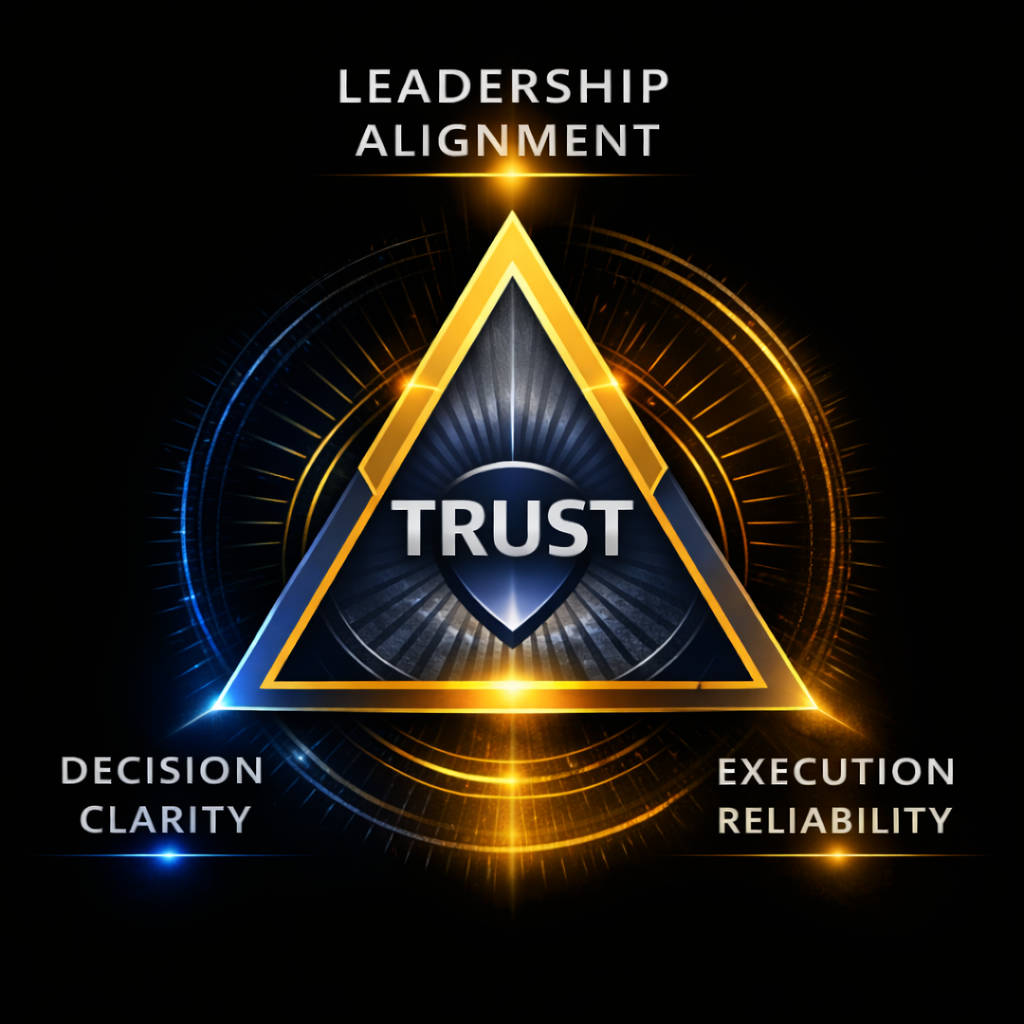
These must hold together—or everything slows down.
The Architecture of Trust Model
Trust inside organizations is reinforced by three structural systems.
When these systems reinforce one another, organizations accelerate.
When they weaken, friction appears and organizational speed declines.
What’s actually breaking
Alignment breaks. Decisions slow. Execution slips.
Most try more communication, more meetings, better people.
It doesn’t work.
These aren’t separate problems.
When alignment breaks, decisions slow.
When decisions slow, execution fails.
This is structural.

The Hidden Trust Tax
You don’t see it.
But you pay for it every day.
Decisions revisited. Work redone. Execution slowed.
What feels like normal friction…
is cost.
Where this shows up
If your organization is growing—but feels harder to run…
If decisions keep getting revisited…
If execution depends on your involvement to get done right…
This isn’t a people problem.
It’s structural.
Debbie Simmons
Creator of Architecture of Trust